
Minimising lentiviral vector losses during sterile filtration
When a lentiviral vector loses activity during sterile filtration, the membrane is an obvious place to begin the investigation. It is also only one part of the system. The product has passed through a pump, contacted tubing and connectors, entered a filter housing and been collected into another container. Each of those steps can affect the final recovery.
In my view, the most productive question is: where is functional vector being lost, and what evidence would distinguish the possible causes? A lower titre after filtration may reflect adsorption, aggregate retention, loss of activity, unrecovered liquid or a combination of these mechanisms. Changing the filter without understanding that distinction can leave the main problem unresolved.
This article focuses on enveloped lentiviral vectors. It considers the filtration assembly as a complete system, with particular attention to pump selection, surface interactions and soft fouling. The objective is to preserve biologically active product while maintaining the required assurance of bacterial retention.
Start with a meaningful measure of recovery
Recovery needs to be based on total quantity, using the measured titre and volume of each relevant fraction. Comparing concentrations alone can be misleading when pre-wetting, formulation or flushing changes the collected volume. The main product pool, development flush fractions, sampling withdrawals and liquid retained in the assembly should be accounted for separately.
Physical and functional measurements also need separate interpretation. A p24 result measures capsid antigen within the capabilities of the method; it does not establish infectivity. A titre derived from cell transduction and subsequent vector copy number measurement reflects the biological and analytical conditions of that workflow. It is not a direct count of intact viral cores.[1]
A higher p24 recovery than functional recovery is therefore a useful investigation signal, but does not establish that pumping or pressure has disrupted the vector. A paired hold control helps assess the contribution of time, temperature and handling. Appropriate analytical controls help establish whether the difference is larger than the variability of the methods.
Make pump selection part of the investigation
A suitably designed low-shear diaphragm pump deserves consideration as an alternative to a peristaltic pump when mechanical exposure is a suspected contributor to loss. This is particularly relevant where material undergoes repeated passages or prolonged pumping. The comparison should examine the actual processing duty and the recovery of functional vector.
A peristaltic pump moves liquid by progressively compressing flexible tubing. Its performance depends on the head and roller arrangement, tubing dimensions and material, occlusion setting, speed and backpressure. The product remains within the tubing, which offers a convenient contained fluid path. Nevertheless, pulsation, repeated compression and release, air entrainment and tubing wear may warrant investigation.
A diaphragm pump moves liquid by changing the volume of a chamber. During suction, the diaphragm retracts and liquid enters through an inlet valve. During discharge, the diaphragm advances and liquid exits through an outlet valve. Suitably designed units can offer gentle transfer, but the chamber, valves, stroke conditions, inlet supply and pulsation still influence performance.
The practical recommendation is to include an appropriate diaphragm pump in the development comparison. The term low shear should describe performance under the intended conditions. It should not be treated as proof that every diaphragm pump will give better recovery than every peristaltic system.
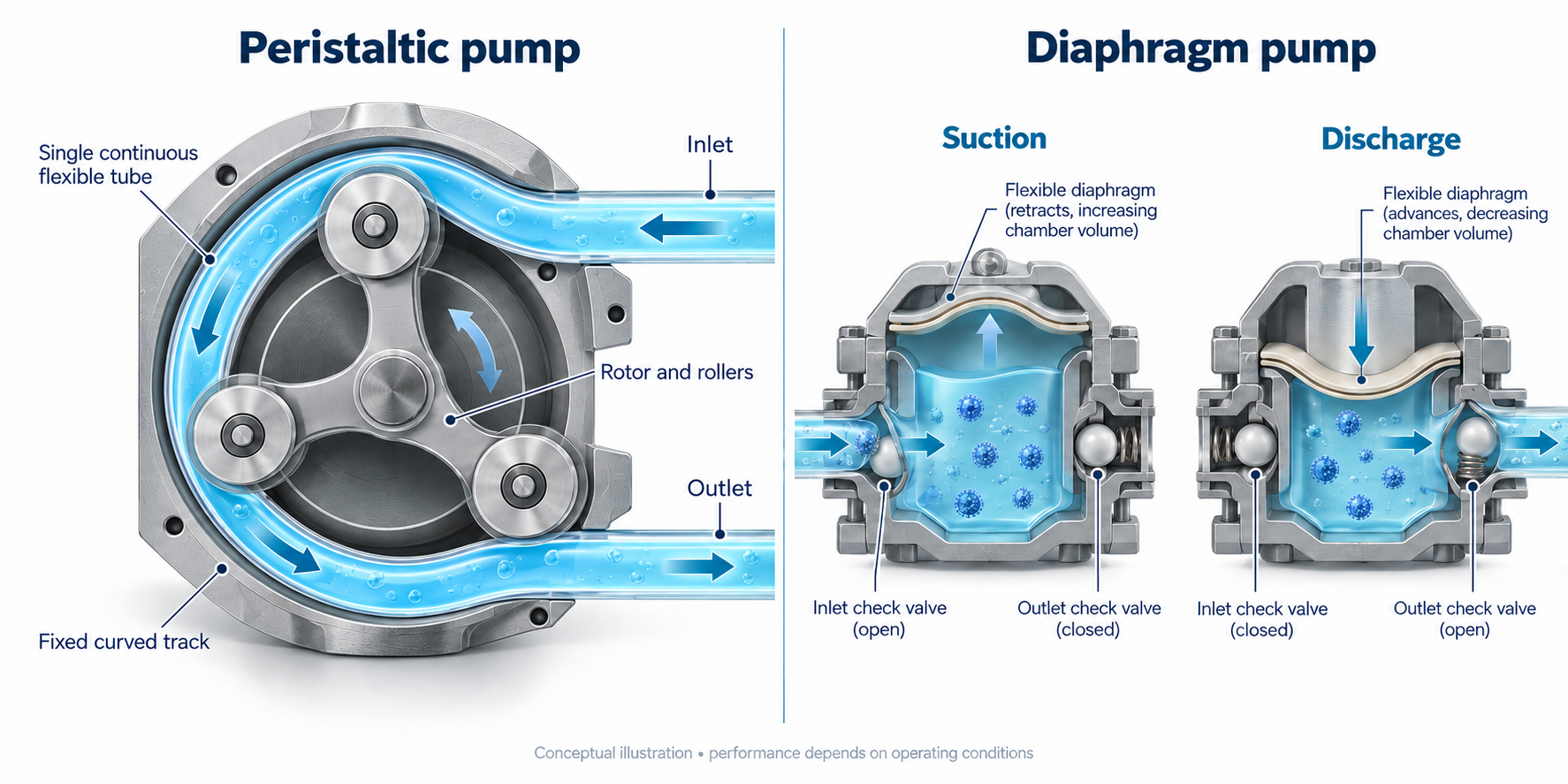
Figure 1. Conceptual comparison of pumping mechanisms. Peristaltic pumping displaces liquid by compressing flexible tubing; diaphragm pumping changes chamber volume with directional valves. The illustration does not establish comparative shear or recovery performance.
Compare the pumps using functional recovery
A useful comparison includes representative product, a hold control and, where practicable, a pump-only assessment before the filter is introduced. Record the required flow, backpressure, duration, temperature and number of passages. Account for pump and tubing hold-up so that a difference in residual volume is not mistaken for a difference in vector stability.
The preferred configuration then needs to be assessed with the filter connected. As resistance develops, the pumping and control behaviour may change. A system that performs well in an unrestricted transfer may behave differently during filtration.
Published research found that higher shear improved recovery in a tangential flow filtration mimic under the conditions examined.[2] This does not establish a preferred pump for single-pass sterile filtration. It reinforces the need to assess the relevant vector and processing conditions.
Separate surface adsorption from mechanical damage
Lentiviral particles can interact with the membrane and with other wetted surfaces, including the housing, tubing and collection container. The significance of adsorption depends on the formulation, surface properties, contact time and the amount of vector relative to the available surface area.
Low recovery in early fractions followed by improved recovery later in the run is consistent with surface conditioning. It is not conclusive evidence, because changing feed properties and other mechanisms can produce similar patterns. Fraction-based measurements and an appropriate bypass comparison help establish where the loss occurs.
Compatible pre-wetting or conditioning may be worth evaluating. Any treatment should be acceptable for the product and assessed for its effect on formulation, bacterial retention, integrity testing and subsequent processing. A membrane described as having low protein binding does not automatically have low binding for an enveloped vector.
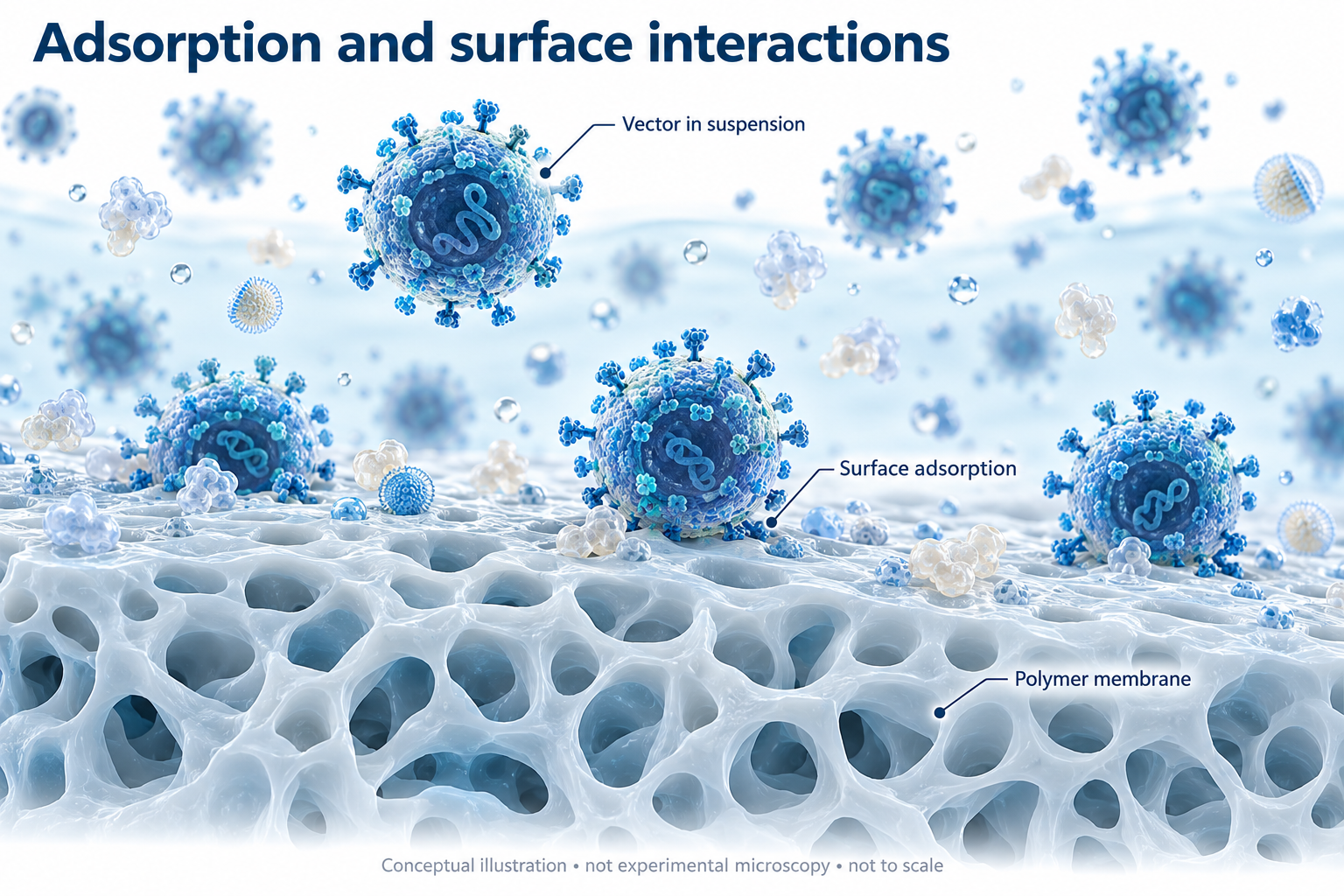
Figure 2. Conceptual surface adsorption of enveloped vector particles. Adsorption can contribute to loss independently of particle damage. Relative dimensions and surface chemistry are illustrative.
Understand what soft fouling can explain
A lentiviral intermediate is a complex particulate system. Depending on the process, it may contain extracellular vesicles, residual proteins, nucleic-acid-associated material and aggregates as well as vector particles. These populations can contribute to pore restriction or accumulation on the upstream membrane surface.
Where deposited material is hydrated and deformable, it may form a compressible layer. Increasing pressure can compact such a layer and reduce the spaces available for liquid flow. Work with model soft colloids demonstrates this general behaviour, although it does not prove that the same deposit forms in a particular lentiviral process.[3]
At controlled flow, developing resistance is observed as a pressure rise. At controlled pressure, it appears primarily as declining flow. Pressure, flow, throughput and time therefore need to be reviewed together. An upstream pressure reading alone may include resistance elsewhere in the assembly.
Soft fouling is a plausible explanation for some filtration behaviour, but a pressure trace does not identify the deposit or demonstrate a gel. Wetting, trapped gas, restricted connections, viscosity and temperature also need consideration before assigning the cause.
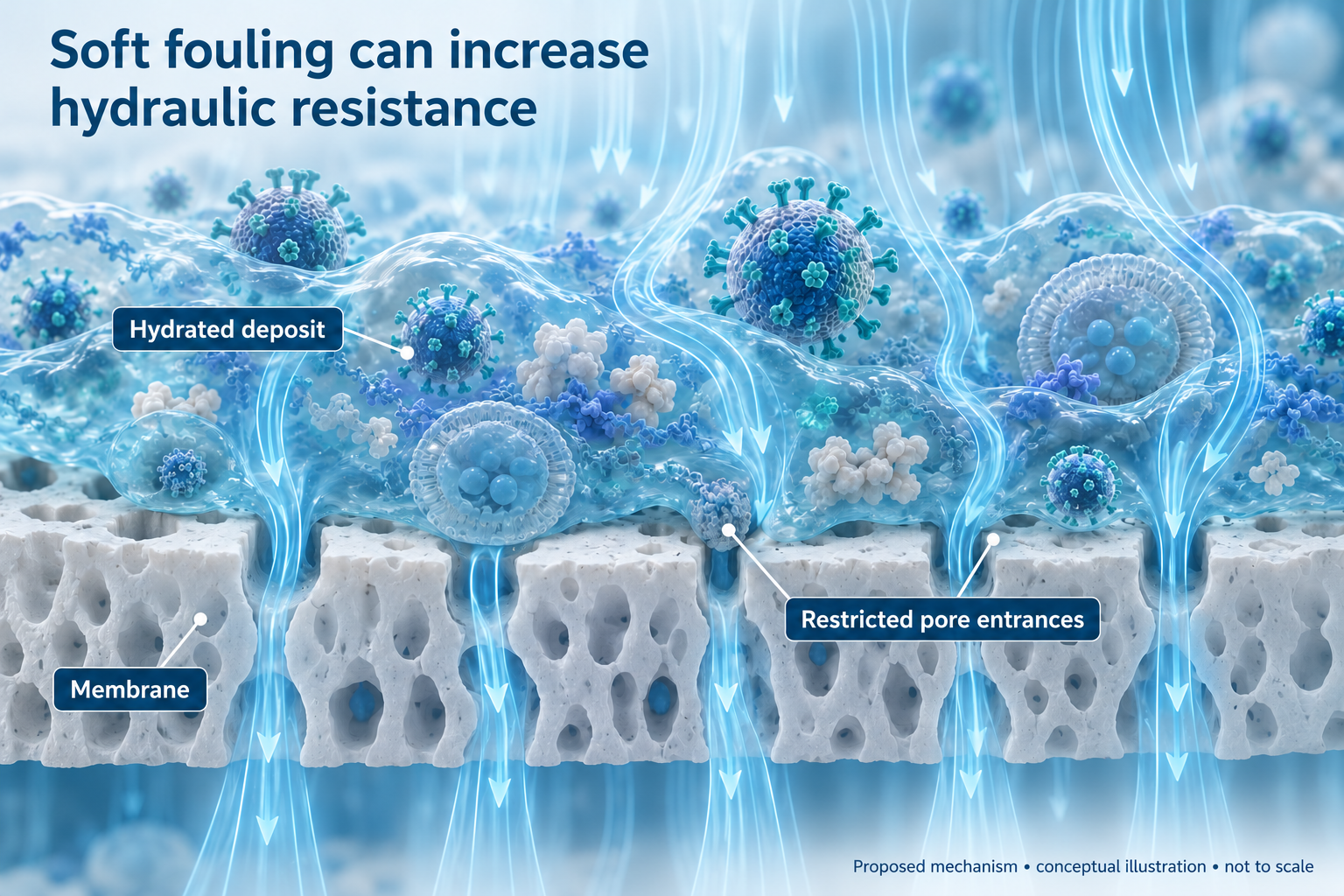
Figure 3. Proposed soft-fouling mechanism. A hydrated deposit can restrict pore entrances and add hydraulic resistance. This is a conceptual illustration rather than evidence of a confirmed deposit from a particular process.
Treat shear damage as a mechanism to test
Excessive mechanical exposure may contribute to envelope deformation, disruption or loss of biological activity in a susceptible vector preparation. Local velocity gradients, interfaces, air entrainment and repeated exposure may be relevant. However, pressure and shear describe different aspects of the system: a high pressure reading is not direct evidence of damaging shear.
Evidence of a mechanical loss should come from controlled functional measurements and suitable supporting characterisation, with handling and analytical effects addressed. Where feasible, this should distinguish loss of activity from adsorption, retained aggregates and unrecovered liquid.
The comparison should also reflect the real process. Repeated circulation through a stress loop may help examine susceptibility, but its results should not be applied directly to a single-pass transfer without accounting for the difference in exposure.
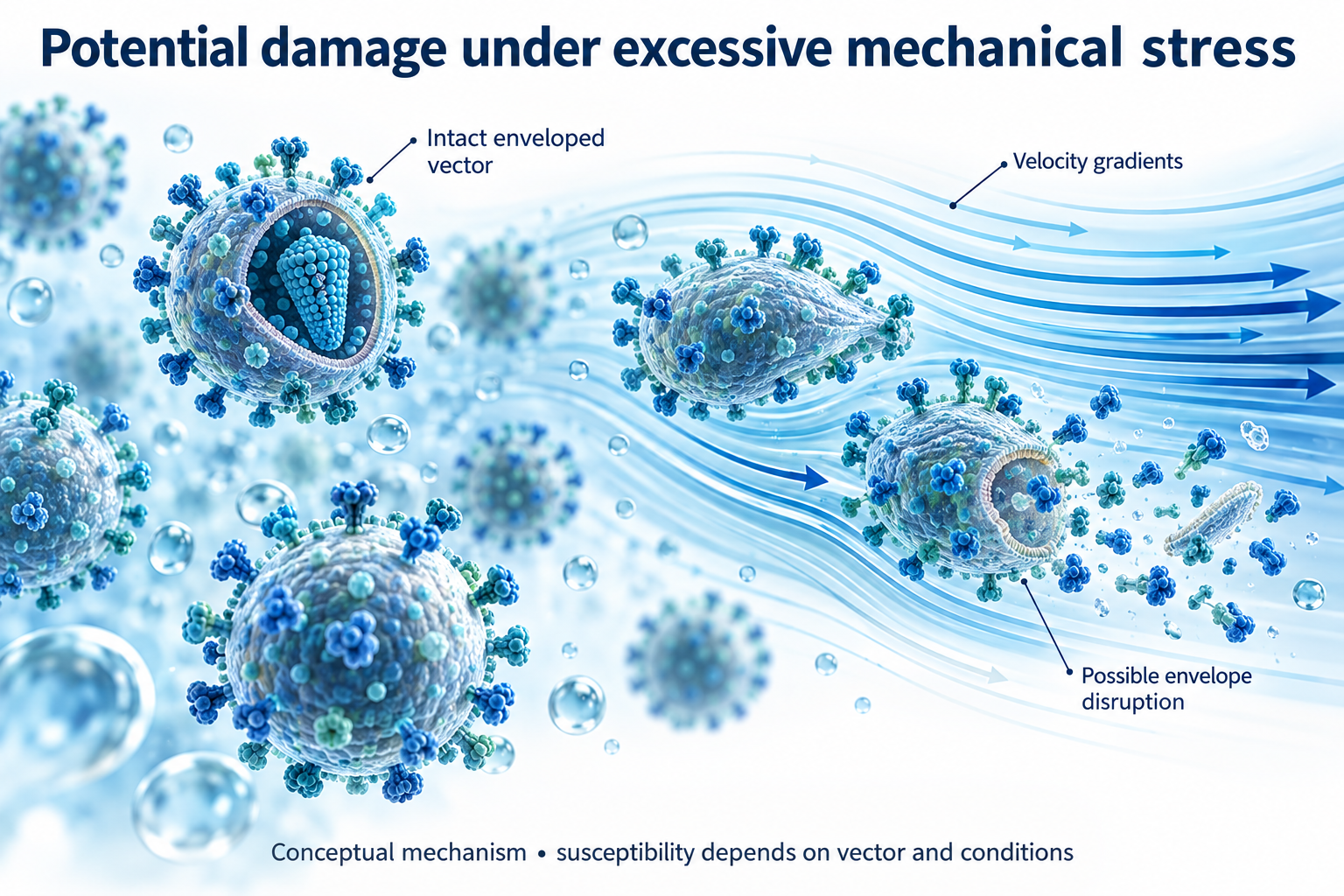
Figure 4. Potential deformation or disruption under excessive mechanical stress. This illustrates a possible mechanism in a susceptible preparation; it does not imply that all shear damages lentiviral vectors or that a particular pump causes the damage.
Balance filter capacity against additional surface area
Increasing membrane area can reduce flux at a given flow and provide additional capacity. It also introduces more surface available for adsorption and may increase retained liquid volume. Oversizing can therefore improve throughput while reducing the proportion of product recovered.
Published lentiviral filtration work supports screening candidate filters with the relevant preparation, rather than selecting solely by nominal pore rating.[4] Compare functional recovery, pressure behaviour, capacity, processing time, hold-up and integrity-test suitability. Assess the intended device and assembly, including any additional membrane layers.
Feed concentration, formulation and residual impurities also influence the result. An added prefilter may protect the final membrane while creating another source of retention. A formulation change may improve surface behaviour while introducing wider product-quality and comparability considerations. The relevant measure is the net benefit across the manufacturing step.
Recover residual product without losing control of the pool
Liquid remaining in a housing, pump or tubing can represent an appreciable loss from a small batch. Quantify that volume and evaluate whether a compatible displacement flush recovers useful functional vector. During development, collect flush fractions separately to establish their contribution and the dilution they introduce.
A larger total recovery is only useful if the resulting product pool remains suitable for subsequent processing or filling. Any flush entering the pool needs to form part of the controlled sterile pathway, with justified pooling criteria. An arbitrary flush volume is a poor substitute for fraction-based recovery data.
Connect the improvement to the validation strategy
Recovery optimisation needs to remain compatible with the sterile filtration strategy. FDA guidance identifies formulation and operating factors that influence filter performance, including pressure, flow, temperature, use time and hydraulic shock.[5] Changes to the pump, formulation, device or operating range should be assessed against the established validation rationale.
Bacterial retention testing and product recovery development answer related but different questions. A deliberately substantial bacterial challenge can change the particulate environment. If an alternative matrix or surrogate is proposed, its suitability needs justification; matching particle size alone does not reproduce the surface properties or deformability of an enveloped vector.
In my view, a useful investigation starts with a reliable recovery calculation, locates the loss and then tests the most plausible mechanism. Pump selection deserves explicit attention alongside membrane chemistry, surface interactions and fouling. The resulting process should deliver reproducible functional recovery, acceptable product quality and defensible bacterial retention assurance.
References
[1] Highly efficient concentration of lenti- and retroviral vector preparations by membrane adsorbers and ultrafiltration. BMC Biotechnology. 2011;11:55. https://pmc.ncbi.nlm.nih.gov/articles/PMC3118112/
[2] Perry C et al. Insights into product and process related challenges of lentiviral vector bioprocessing. Biotechnology and Bioengineering. 2024. https://doi.org/10.1002/bit.28498
[3] Lüken A et al. Particle movements provoke avalanche-like compaction in soft colloid filter cakes. Scientific Reports. 2021;11:12836. https://doi.org/10.1038/s41598-021-92119-w
[4] Vogel JE et al. High yield sterile filtration process for highly concentrated lentiviral vectors. Biotechnology Journal. 2024;19:e2300348. https://doi.org/10.1002/biot.202300348
[5] FDA. Sterile Drug Products Produced by Aseptic Processing — Current Good Manufacturing Practice. September 2004. Section IX B. https://www.fda.gov/media/71026/download
Illustration notes
All four images are AI-generated conceptual illustrations, not experimental observations or microscopy. Particle dimensions and relative scales are illustrative. The pump comparison explains operating principles and does not quantify shear or establish superiority of a pump type.