Building regulatory fluency across biologics and advanced therapies
- Client
- Regulatory affairs team within an international pharmaceutical-sector organisation
- Service
- Bespoke technical training design and delivery
- Status
- Two-day programme developed and delivered
The challenge
A regulatory affairs team required a structured programme to strengthen its understanding of biologics and advanced therapy medicinal products (ATMPs).
The subject required more than an overview of terminology. Professionals working across these product areas need to connect regulatory concepts with the scientific characteristics, manufacturing processes and quality considerations that underpin them.
The assignment was to develop a substantial two-day programme that made this complex material accessible to a professional audience while retaining sufficient technical depth to support meaningful discussion.
A further consideration was how participants would use the material afterwards. With a substantial volume of content to cover, the programme needed to support engagement during the sessions and provide useful reference material beyond the event.
The contribution
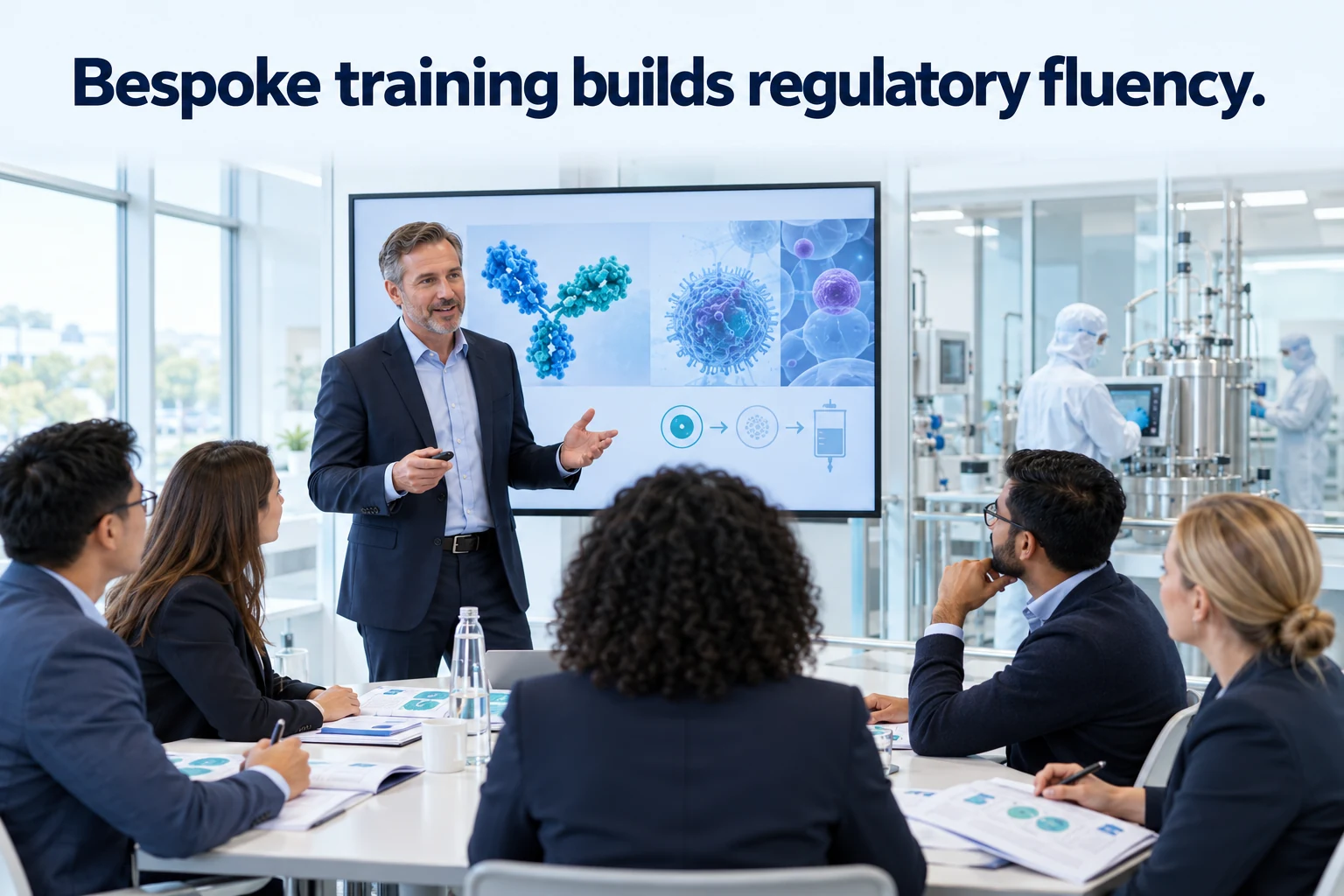
Jon developed and delivered a bespoke programme focused on regulatory fluency across biologics and ATMPs.
The work included programme development, preparation of presentation materials and accompanying explanatory narrative, and delivery of the two-day event.
The emphasis was on helping participants connect the subject matter with their professional responsibilities. Jon brought his experience in pharmaceutical quality, compliance and manufacturing to the explanation of technically demanding topics.
The approach
Giving the programme a clear purpose
The programme was framed around regulatory fluency: enabling participants to engage more confidently with the language and concepts encountered across biologics and advanced therapies.
This provided a consistent purpose for the training. Technical information needed to be explained in a way that supported understanding and discussion, while recognising that a two-day course forms part of continuing professional development.
Developing material for delivery and subsequent reference
Jon prepared presentation content supported by an accompanying narrative.
The materials were designed to serve two purposes: to guide the sessions and to provide participants with a resource they could revisit afterwards.
Before the event, participants were advised that the presentation materials and supporting narrative would be supplied. This reduced the need to capture every detail in handwritten notes and allowed greater attention to be given to explanations and discussion.
Encouraging questions throughout
Delivery adopted an informal, interactive approach. Participants were encouraged to ask questions as topics arose rather than waiting until the end of a presentation.
This created opportunities to clarify unfamiliar concepts at the point they were introduced and to explore questions relevant to the audience.
The approach recognised that professional training is most useful when participants can test their understanding and relate the material to situations they encounter in their work.
Connecting technical explanation with practical experience
Jon’s quality and manufacturing background provided context for the regulatory subject matter.
This supported explanations that connected scientific and manufacturing considerations with the questions regulatory professionals need to understand and communicate.
The value of the programme lay in the combination of structured content, explanatory material and access to an experienced practitioner during delivery.
The outcome
The bespoke two-day programme was developed and delivered, with presentation content and supporting explanatory material prepared for participant reference.
The assignment provided a substantial training resource addressing a defined professional development need.
Its immediate outcome was delivery of the programme and creation of reusable learning materials. Any improvement in participant competence or subsequent workplace performance would require separate assessment and is not claimed here.
What this assignment demonstrates
The project demonstrates Jon’s ability to develop and deliver technically substantial training for a specialist professional audience.
It illustrates an approach that combines clear explanation, practical experience and discussion, supported by materials that remain useful beyond the training event.
Client names, locations, personnel, dates and identifying project details have been omitted to preserve anonymity.